







Playa Giron Battle Turns Cuba Into an Anti-Imperialist Symbol
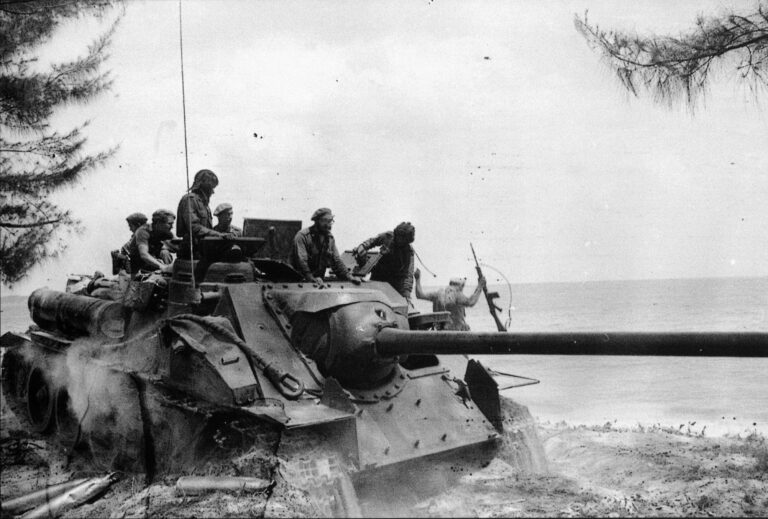
Fidel with Cuban wrestlers in a defensive tank. Photo: X media
April 17, 2026 Hour: 2:13 pm
🔗 Comparte este artículo
In 1961, Cuban military forces and popular militias defeated U.S.-trained mercenaries in less than 72 hours.
The history of the 20th century often focuses on rivalries between great powers. Yet a few moments changed the Cold War’s path as much as the failed Bay of Pigs invasion, which Cubans call the victory at Playa Girón.
Some analysts see it as a tactical mistake by the Kennedy administration, but records reveal a deeper story. This was no mere skirmish; it became a defining stand for Cuban sovereignty, turning a small Caribbean Island into a global symbol of resistance against imperialism.
The April 1961 invasion capped years of growing tension between Cuba’s young revolutionary government and a United States used to dominating its “backyard.” Global South outlets see it as the spark that radicalized the Cuban Revolution and reshaped the geopolitics of the Western Hemisphere.
To grasp this event, in this In-Depth article, we must look past the beach battles to the social and economic forces that made conflict unavoidable.
The Prelude of Playa Girón: Agrarian Reform to Economic Warfare
The roots of the Bay of Pigs invasion go back before troops landed in April 1961. After the Cuban Revolution triumphed in January 1959, Fidel Castro’s government acted quickly to dismantle old colonial land structures.
The First Agrarian Reform Law of May 1959 lit the fuse. It redistributed vast estates, many owned by U.S. giants like the United Fruit Company, pushing a vision of social justice that hit American business hard.
Washington struck back quickly, shifting from diplomacy to economic war. Historical archives in Cuba show how the U.S. saw these reforms not as Cuba’s internal choices, but as a slide toward the Soviet bloc.
Tensions boiled over in 1960 when Cuba asked U.S.-owned refineries to process Soviet oil. They refused on State Department orders, so Cuba nationalized them. President Eisenhower hit back by cutting Cuba’s sugar quota, aiming to cripple the island’s main income source.
In March 1960, the French ship La Coubre exploded in Havana harbor while unloading Belgian munitions for Cuba’s defense. Cuban leaders blamed CIA sabotage. Soon after, Eisenhower greenlit “Program 4-13,” a secret effort to train Cuban exiles for invasion.
When John F. Kennedy took office in early 1961, the plans were rolling. The diplomatic break in January made clear: talks were over, and Playa Girón loomed.
The 72-Hour Clash: Defending the Zapata Swamp
The assault kicked off in the pre-dawn hours of April 17, 1961. About 1,400 CIA-trained exiles in Brigade 2506 hit beaches at Playa Girón and Playa Larga. Planners picked the spot for its remoteness, ringed by the huge Zapata Swamp.
They thought it would let invaders hold ground while a provisional government flew in from Miami. But that isolation turned into a nightmare. The swampy, rough land bogged down their heavy gear, and tight roads left columns exposed to Cuban fire.
Cuba’s response outpaced U.S. expectations. The CIA bet on a local uprising to aid the invaders. Instead, charcoal burners and peasants, who had gained from the Revolution’s literacy drives and land reforms, formed the first defense line.
As National Revolutionary Militia members, they slowed Brigade 2506, buying time for the Cuban army and artillery to arrive. By the time the invaders saw no revolt coming, Cuban forces had them trapped against the sea, growing stronger each hour.
Air control sealed the invaders’ fate. U.S. strikes on April 15 aimed to destroy Cuba’s air force, but some Revolutionary Air Force jets survived. They sank key Brigade supply ships, the Houston and Río Escondido, loaded with most ammo and fuel. Cut off, the Brigade crumbled. By April 19 afternoon, survivors surrendered after less than three days.
Iconic Figures and the Leadership Gap
The Bay of Pigs highlighted sharp differences in leadership and resolve. Fidel Castro led Cuba’s defense personally. Some Outlets show him rolling up to the front in a T-34 tank, a powerful symbol.
At the “Point 0” command post, his presence signaled that leaders would fight and die with their troops. This direct style clashed with Washington’s remote, wavering command.
On the ground, José Ramón Fernández, “El Gallego”, ran the tactics. A former pro-soldier who joined the Revolution, he turned ragtag militias into a unified force that mastered the Zapata terrain. His work shifted local defense into a counterattack, driving invaders to the sea
Brigade 2506’s leaders and U.S. handlers lacked unity. José Pérez San Román, a Batista-era officer, commanded, but his past alienated Cuban peasants. In Washington, Kennedy balanced anti-communism against Soviet war fears.
He withheld air support at the landing crunch time, stranding the Brigade. This bred lasting bitterness among Cuban exiles. Cuba’s focused command filled the gap.
Immediate Aftermath: The “Compota” and Global Shift
After the April 19 collapse, odd diplomacy followed. Cuba captured 1,189 Brigade members. Initial tough penalties gave way to humanitarian steps. Televised trials, watched by global media, led to Fidel Castro’s exchange offer.
Prisoners went free for $53 million in baby food (compota in Cuba), medicines, and farm gear. It aided a blockaded nation and painted the U.S. as the aggressor, making amends.
The flop reshaped Cuba’s defenses and world role. Fearing a bigger U.S. strike, Havana locked into a full Soviet alliance. The USSR turned from trade partner to “nuclear shield,” paving the way for 1962’s secret missiles and the crisis.
Playa Girón thus escalated a local fight to nuclear brinkmanship. It exposed the “Kennedy Doctrine” of covert containment as a bust.
The win rippled outward. For Latin America’s left and Global South movements, Cuba proved small nations could beat the U.S. This fired up continental revolutionaries. Cuba exported doctors, teachers, and later advisors to places like Algeria and Angola. Girón’s spirit fueled Cuban internationalism, making the island a key anti-colonial force.
The Long Shadow of the Blockade
The Bay of Pigs’ legacy shines in the U.S. blockade. After seeing the invasion’s high costs, the U.S. turned to an economic squeeze.
February 1962 was locked in the full blockade, a core U.S.-Cuba flashpoint today. Sources call it a tool Cuba blames for woes, while the world sees it as a failed regime-change bid after six decades.
April 1961 forged Cuba’s “fortress mentality.” The defense myth, of people armed against an empire, endures. It frames today’s diplomacy and dissent as “new Giróns.” Zapata’s beaches still echo a shattered American order.
The Bay of Pigs was more than a failed landing. It ended the U.S. power to force Cuba’s affairs by arms. Seen as betrayed democracy or sovereign heroism, it anchors history.
Sources: Granma – Cuba Debate – CubaRed – La Tizza – Brasil de Fato – TeleSUR – Página 12 – BBC
Author: Silvana Solano
Source: teleSUR